through the successful implementation of its third oral rabies vaccination (ORV) campaign. Conducted from 28 September to 9 October 2026, the campaign combined both parenteral and oral rabies vaccination (ORV) approaches, building on the remarkable successes achieved during previous ORV initiatives and further improving vaccination coverage across the region.
The campaign was implemented by the Directorate of Veterinary Services (DVS), with technical support from the World Organisation for Animal Health (WOAH) and Friedrich-Loeffler-Institute (FLI), Germany. Eight vaccination teams were deployed across villages and communities in areas that were not covered during the May-June 2026 mass dog vaccination campaign using conventional injection-based methods.
Namibia’s journey with Oral Rabies Vaccination has attracted international attention as an innovative strategy for reaching free-roaming dog populations that are often missed during conventional mass dog vaccination campaigns. The country adopted ORV as a complementary tool to support its National Rabies Control Strategy and contribute to the global goal of eliminating human deaths from dog-mediated rabies by 2030.
The first major breakthrough came in 2022, when an Emergency ORV intervention was conducted in the Zambezi Region, an area with an estimated dog population of around 19,000 and a human population of approximately 142,000. During the four-day campaign, four vaccination teams vaccinated 3,097 dogs, with 88% of dogs offered a vaccine bait considered successfully vaccinated. Teams achieved an average vaccination rate of more than 23 dogs per hour, demonstrating the feasibility and effectiveness of ORV under African field conditions, and Zambezi Region in particular.
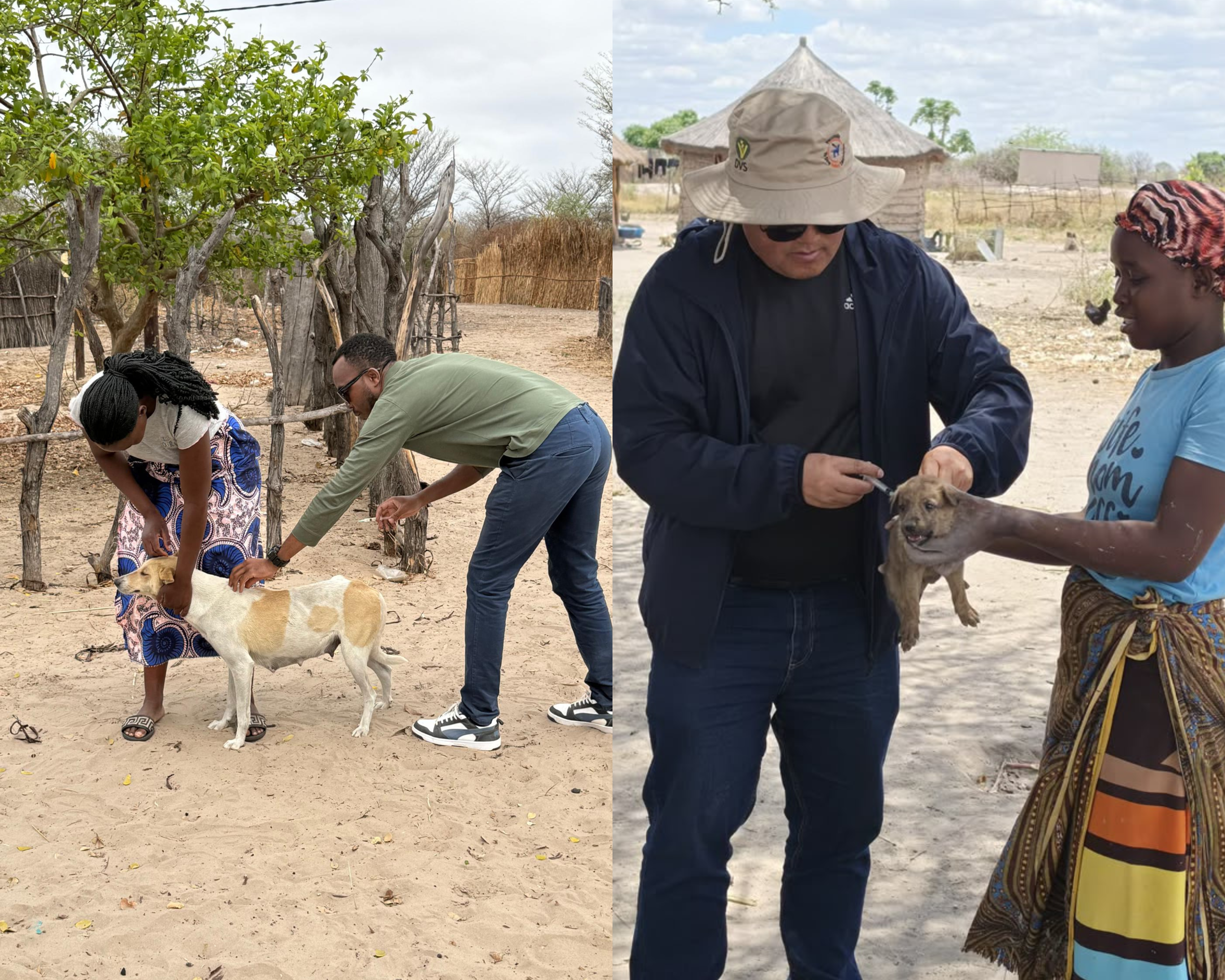
Concurrent parenteral and oral rabies vaccination of dogs in the Zambezi Region during the September-October 2026 campaign. Photo @ T.Tenzin ( WOAH).
representing the Africa’s largest field trial of oral rabies vaccination in dogs at the time. Ten mobile teams offered vaccine baits to 9,343 dogs and successfully vaccinated approximately 48% of the regional dog population over four working days. Combined with previous parenteral vaccination at the central-point and complementary ORV vaccination activities, overall vaccination coverage in the Zambezi Region increased to approximately 69%, approaching the critical threshold required to interrupt rabies transmission. Subsequent evaluation study conducted in 2024 confirmed increased vaccination coverage and a reduction in rabies incidence, providing strong evidence that integrating ORV into rabies control programmes can significantly enhance disease control efforts in areas with large free-roaming dog populations through increasing vaccination coverage.
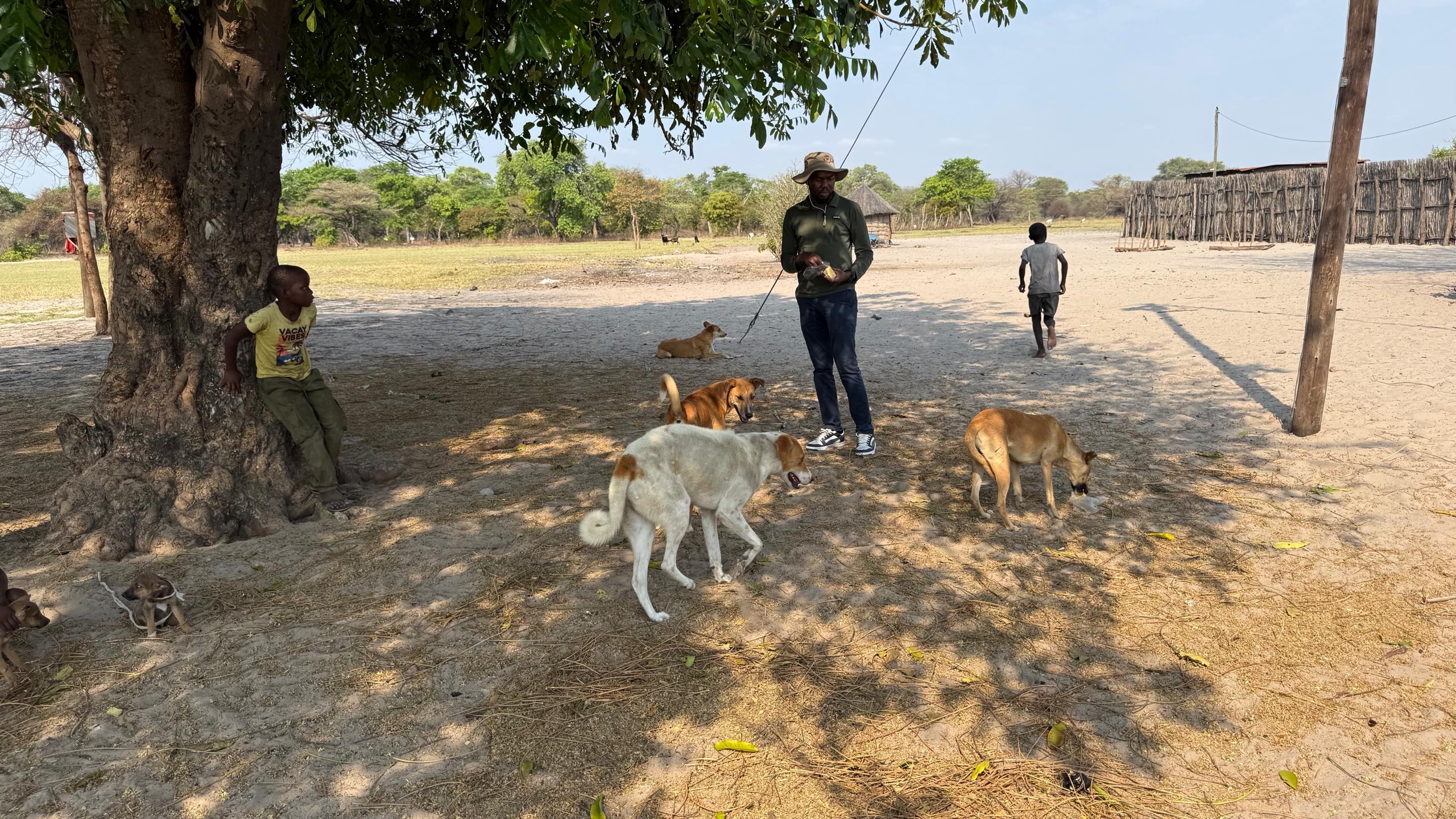
The 2026 campaign marked another important milestone by implementing a combined vaccination strategy, with teams administering injectable vaccines to the puppies and juvenile that are easy to handle while simultaneously deploying oral vaccine baits to free-roaming, hard-to-handle and adult dogs. This integrated approach enabled vaccination teams to reach a wider proportion of the dog population. In Namibia, parenteral (injectable) rabies vaccination is primarily delivered through central-point vaccination campaigns, where dog owners bring their animals to designated vaccination sites. In contrast, oral rabies vaccination (ORV) integrated with parenteral vaccination was implemented using a door-to-door (house-to-house) approach, whereby vaccination teams visit households, villages, and remote communities directly. This strategy improves access to free-roaming and difficult-to-handle dogs, enhances vaccination efficiency, and increases overall vaccination coverage within the target population. Similar door-to-door approach combining ORV and parenteral vaccination was implemented in Kavango East Region in May 2026 that improved the vaccination coverage from 14 to 32%.
The use of ORV enabled vaccination teams to efficiently reach dogs that are often inaccessible through conventional central-point vaccination campaigns, particularly free-roaming, difficult-to-handle, or ownerless dogs. ORV also facilitated the vaccination of dogs that were not presented by their owners at central vaccination points, thereby increasing overall vaccination coverage and improving population immunity against rabies.
The integration of ORV with conventional injectable vaccination markedly enhanced the overall reach of the programme. Combined with the earlier parenteral mass dog vaccination campaign implemented in May-June 2026, the estimated canine rabies vaccination coverage increased from 16% to 39%, representing a substantial improvement in population immunity and progress toward rabies elimination objectives. Community members responded positively to the campaign, reflecting growing awareness of rabies prevention and confidence in vaccination activities. Although the combined ORV-parenteral vaccination campaigns increased overall vaccination coverage, their operational efficiency was lower than that observed during the stand-alone ORV campaigns conducted in the Zambezi Region in 2022 and 2024. The integrated campaigns in the Kavango East and Zambezi regions achieved fewer vaccinations than anticipated because parenteral vaccination requires additional time for dog handling, vaccine preparation, and injection. Campaign efficiency was further influenced by logistical factors, such as vehicle availability and the experience of vaccination teams. As a complementary tool, ORV is intended to enhance vaccination efficiency by reaching large numbers of dogs, particularly free-roaming and hard-to-handle animals, within a short period, thereby improving the cost-effectiveness of rabies control programmes. In addition, the campaign faced few logistical and operational challenges, including an insufficient number of vaccination teams and limited vehicle availability. Campaign implementation was further affected by competing national animal health priorities, particularly concurrent FMD outbreaks in the //Karas Region and the Zambezi Region, which occurred during the same period as the rabies vaccination campaign.
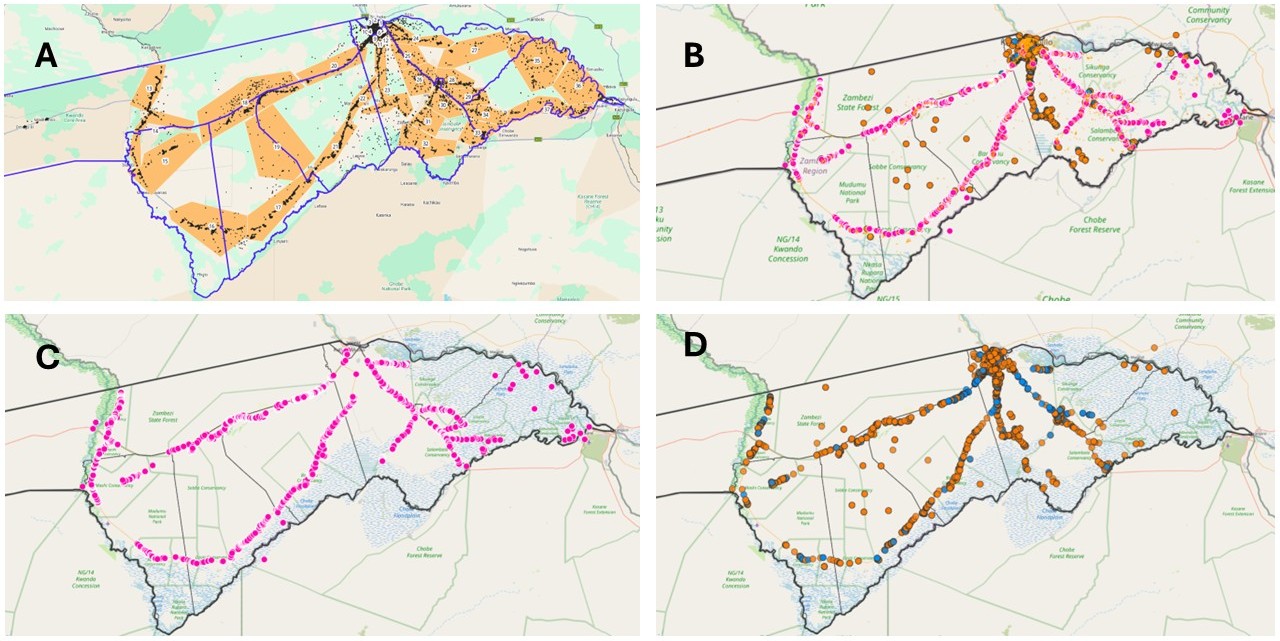
GARC Data Platform digital tools were used to capture and monitor vaccination progress, helping teams identify gaps and direct the team to under covered areas. In addition, application of Geo Tracker- GPS Tracker tool combined with building footprints of the vaccination areas enhances vaccination planning and monitoring. The strategy built upon lessons learned from the previous campaign in Kavango East Region, further strengthening the effectiveness of vaccination operations in the region.
Map of the Zambezi Region, Namibia, showing: (A) demarcation of vaccination zone with building footprints (dark dots); (B) locations where dogs were vaccinated using oral (pink) and parenteral (orange) vaccination methods; (C) locations of orally vaccinated dogs (pink); and (D) locations of parenterally vaccinated dogs (orange). Base map downloaded from the GARC Data Platform. Figure prepared by T. Tenzin (WOAH).
The progressive increase in vaccination coverage achieved through repeated campaigns demonstrates the value of combining conventional and innovative vaccination approaches. By systematically expanding dog vaccination coverage and reaching previously missed populations, Namibia is moving closer to achieving sustainable rabies control in the Zambezi Region.
The success of the 2026 campaign reinforces the growing evidence that oral rabies vaccination can serve as an effective complementary tool to mass dog vaccination programmes in Namibia. The experiences gained in Zambezi and Kavango East Regions are expected to inform rabies elimination efforts elsewhere in Namibia and across Africa.
As Namibia continues to strengthen surveillance, community engagement, and dog vaccination programmes, the country is emerging as a regional leader in the practical application of oral rabies vaccination and in the pursuit of the global goal of Zero Human Deaths from Dog-Mediated Rabies by 2030.