FIRABioT
Fortifying Institutional Resilience Against Biological Threats
Read more
The Department of Animal Health and Livestock Development (DAHLD) of Malawi’s Ministry of Agriculture, with the support of the World Organisation for Animal Health (WOAH), convened a technical workshop to validate the country’s first National Anthrax Contingency Plan (NACP).
Held in Lilongwe from 21 to 24 September 2026, the validation workshop brought together experts from animal health, public health, law enforcement, and disaster management institutions to test whether the draft plan, developed during a drafting workshop in Blantyre in August, would work under real operating conditions and provide practical guidance to responders.
Anthrax continues to affect wildlife, livestock, and people in Malawi. An outbreak in Liwonde National Park in 2018 and human cases in Mzimba district in 2023 demonstrated the importance of clear roles, coordination across sectors, and timely laboratory confirmation. Because anthrax can also result from accidental or deliberate release, preparedness requires a plan that covers natural, accidental, and deliberate events under a whole-of-government approach.
Recognising these challenges, Malawi, as a beneficiary of the Fortifying Institutional Resilience Against Biological Threats (FIRABioT) Project, requested support for the development of a national anthrax contingency plan. The plan is intended to strengthen coordination between sectors and improve the country’s preparedness and response to anthrax and other biological threats.
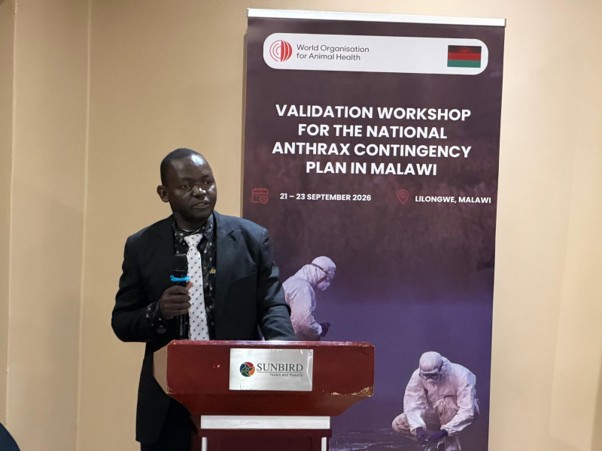
Mr Joseph Hamie, Director of Veterinary Services of the Department of Animal Health and Livestock Development under the Ministry of Agriculture, Irrigation and Water Development making opening remarks at the validation workshop. Picture © N. Atama (woah) 2026.
The workshop was officially opened by Mr Joseph Hamie, Director of Veterinary Services, who acknowledged WOAH’s support and highlighted the relevance of the plan for preparedness and response to anthrax and related outbreaks. Mr Joseph Bitilinyu, Director of Public Health, also addressed participants, reflecting the shared responsibility of the animal and human health sectors.
The validation began with a tabletop exercise. Four working groups tested the draft plan against three scenarios: a laboratory biosecurity breach, an outbreak complicated by misinformation, and a suspected crime scene that collided with a public health response. The exercise helped identify gaps and assess whether the plan provided sufficiently clear guidance for responders managing an event. Participants then reviewed the document and proposed revisions based on the issues identified during the exercise.
The review resulted in several important changes. Participants clarified leadership arrangements for an outbreak response, with the Ministry of Health taking the lead when the first case is human and the Ministry of Agriculture when it is animal. They also agreed to use functional titles rather than names of individuals or specific ministries, helping the plan remain applicable if government structures change. Finally, the document was reorganised into a more concise operational core, with detailed technical procedures moved to annexes to make essential guidance easier to access in the field.
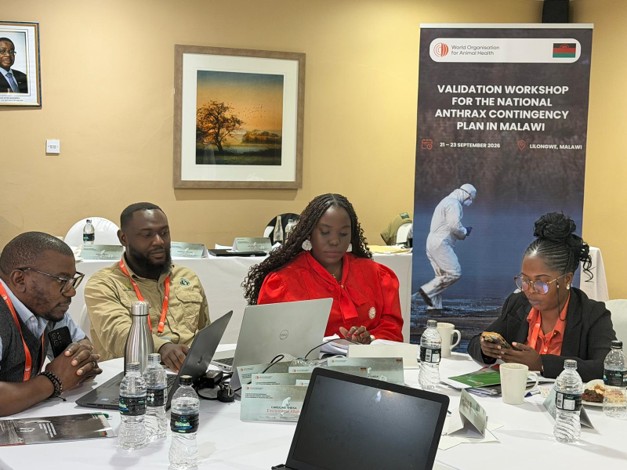
Participants reviewing the draft National Anthrax Contingency Plan during the validation workshop in Lilongwe. Picture © N. Atama (woah), 2026.
The validation marks an important milestone in strengthening Malawi’s preparedness for anthrax and other biological threats. The plan will now be submitted to the relevant Government Ministries for formal endorsement. Once adopted, it will provide a framework for a coordinated, timely, and science-based response, further strengthening national and regional health security.
The validation of Malawi’s National Anthrax Contingency Plan forms part of the country’s activities as a beneficiary of the FIRABioT Project. This project is funded by Global Affairs Canada‘s Weapons Threat Reduction Programme in support of the Global Partnership’s Signature Initiative to Mitigate Biological Threats in Africa.