
Dakar, Senegal
Summary of the P3V webinar (3/5): the real needs of women and young livestock farmers and the P3V Project's response
November 28, 2025
Read more
On 26 November 2025, the World Organisation for Animal Health (WOAH), with the support of the French Development Agency (AFD), organised a webinar on the impact and capitalisation of the ‘Professionalisation of Veterinary Para-professionals’ Project (P3V). This event aimed to highlight the project’s results, the lessons learned from its implementation, and the prospects for consolidating and sustaining its achievements.
This article is part of a series of five contributions from this webinar, each corresponding to a presentation. Following an initial article devoted to a general presentation of the P3V Project, a second article analysing its impacts and the lessons learned from its implementation, and a third article focusing on the analysis of the real needs of livestock farmers, this fourth article focuses on capitalising on the approaches, tools and lessons learned from the implementation of the Project.
This fourth article is based on the presentation given by Dr Camille Delavenne and Ms. Catriona Mackenzie from EpiMundi. This session highlighted how the P3V Project structured the documentation, analysis and dissemination of its findings, with a view to ensuring the sustainability of its results and preparing for the transferability of the model to other contexts.
Now in its final phase, with completion scheduled for June 2026, the P3V Project has embarked on a proactive capitalisation process, considered a central pillar for sustaining its achievements. Capitalisation is understood as a structured process of documentation and learning, aimed at:
This approach addresses a key challenge: preventing the knowledge accumulated over several years from being lost when Project funding ends.
The P3V capitalisation process is based on a rigorous methodology, structured around several complementary stages:
This methodology is less about producing an additional impact assessment than about structuring a Project memory that can be used beyond the project’s lifetime.
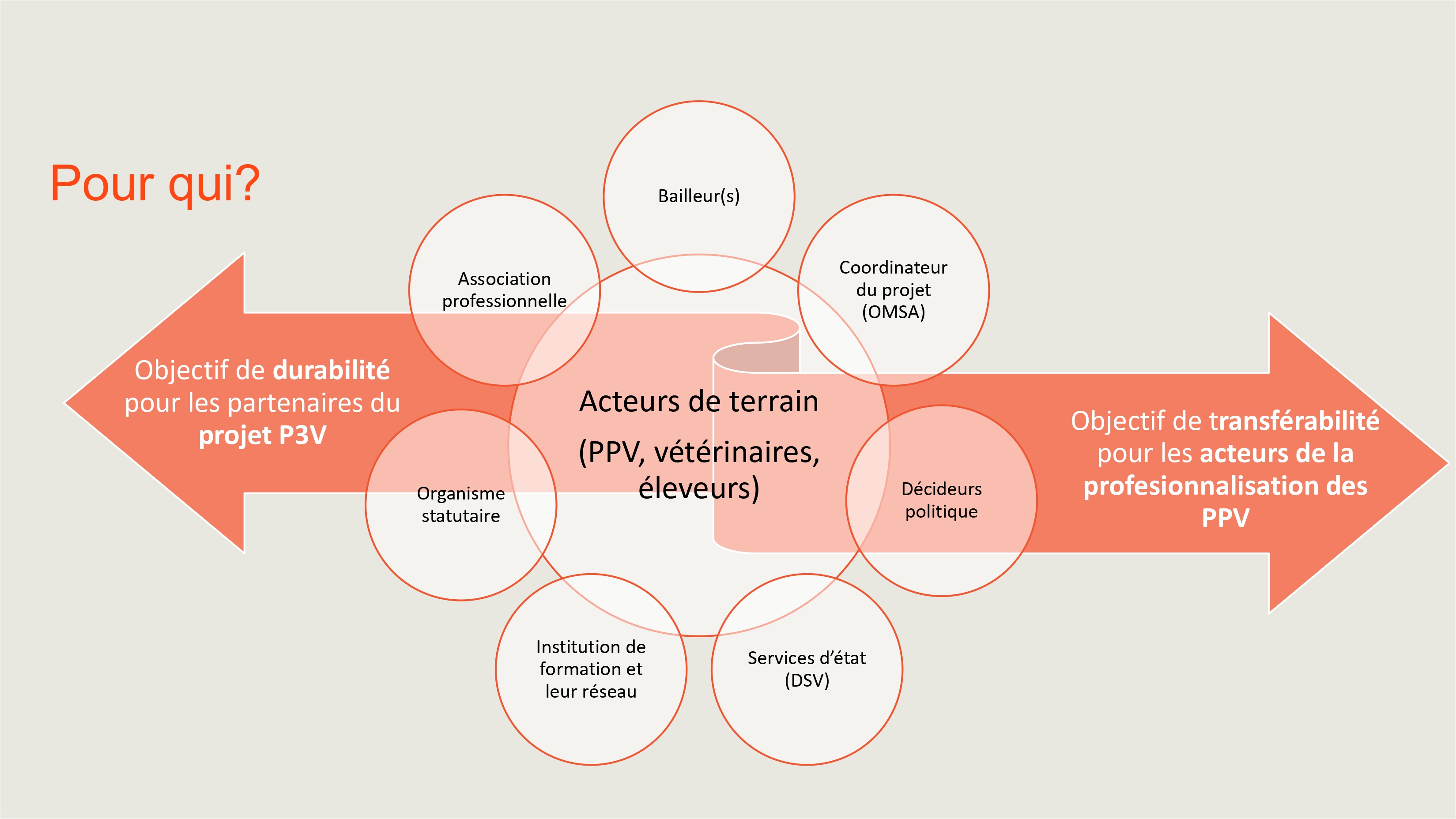
The tools developed as part of P3V are project-wide, with a regional focus. They do not constitute a comparison between countries, nor are they specific to a particular institute or isolated national context.
Their added value lies in their ability to:
This approach recognises that transferability cannot be mechanical but is based on a contextualised appropriation of tools and lessons learned.
Capitalisation has revealed several conditions for success that are essential to the sustainability of the P3V model:
These elements constitute a structural foundation for any initiative aimed at the sustainable professionalisation of veterinary paraprofessionals (VPPs).
The overall results highlighted by the capitalisation demonstrate an increase in skills at several levels:
This webinar presentation emphasises that capitalisation is not a secondary activity, but a strategic lever for sustainability and transferability. By structuring and sharing the lessons learned from P3V, the Project has laid the foundations for a collective memory that can be mobilised by national and regional actors.
These achievements provide essential support for promoting the adoption of tools, strengthening political advocacy and supporting the expansion of the P3V model. They pave the way for the fifth and final article in the series, which focuses on the conditions for transferring the P3V to other countries.
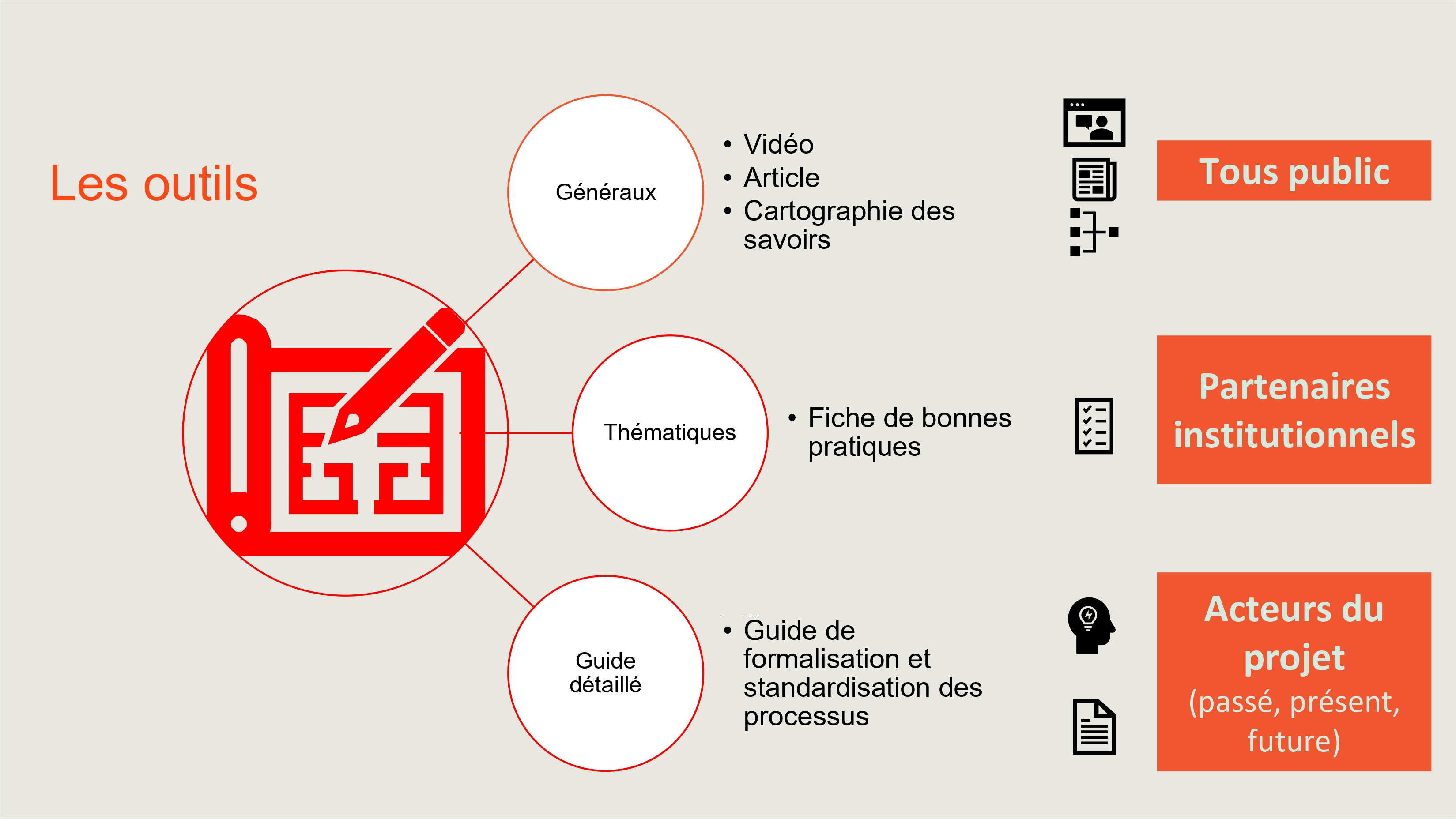
Capitalisation tools, Dr. Camille Delavenne and Ms. Catriona Mackenzie (EpiMundi). In French