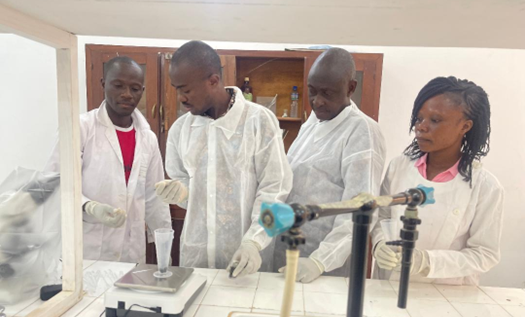



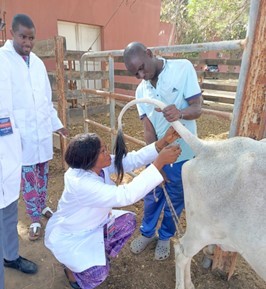
P3V Project supports training of teachers in microbiology, biochemistry-haematology and the design of dummies as part of a skills lab at EISMV in Dakar.
May 16, 2025
Read more
From 12 to 16 May 2025, the Inter-State School of Veterinary Science and Medicine (École Inter-États des Sciences et Médecine Vétérinaires, EISMV) in Dakar hosted a regional training course for teachers from partner institutions involved in the P3V project. This session, focused on the design and use of dummies in simulation laboratories (LaboSim), brought together seven trainers from Senegal, Togo and Benin.
The objective? To strengthen their teaching skills for better transmission of clinical procedures to future veterinary paraprofessionals (VPPs).
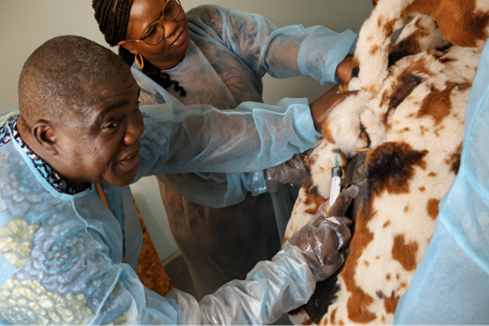
Aware of the limitations of overly theoretical training, participants were invited to explore concrete, accessible and reproducible methods. Throughout the week, they learned how to design simulators using local materials, build appropriate teaching scenarios, and integrate simulation into their teaching practices. From making skin and horse foot simulators to obstetric scenarios, each workshop aimed to bring the training closer to the realities of the field encountered by VPPs.
This approach also helps to protect the health and well-being of animals by preventing students who are still learning from performing imprecise procedures directly on them, which could cause stress or suffering. Simulation is therefore an ethical, progressive and effective tool for strengthening practical skills.
Démonstration des mannequins fabriqués au cours de la formation. Photo (c) A. P. Bedekelabou (omsa) 2025
Demonstration of dummies made during the training course. Picture (c) A. P. Bedekelabou (woah) 2025.
The training was designed to be highly participatory. Each session combined theory, demonstration and hands-on practice, with daily discussions to tailor the methods to the profile of the institutions represented. The educational results are encouraging average scores rose from 66% in the pre-test to 97% in the post-test. All participants achieved a high pass rate, indicating effective assimilation of the targeted skills. The studious and collaborative atmosphere also helped to strengthen ties between trainers from different countries, in a spirit of regional co-construction.
At the end of this training course, participants leave with concrete tools and a renewed vision of their role. Several perspectives were discussed: the creation of common manuals, the implementation of assessment grids, the expansion of simulated scenarios and the creation of video materials for self-training. The creation of an inter-school network and the organisation of regular refresher courses are also among the avenues to be explored.
Remise des certificats aux participants. Photo (c) A. P. Bedekelabou (omsa) 2025 IIIIIII Issuing of certificates to participants. Picture (c) A. P. Bedekelabou (woah) 2025